At the Coachella Valley Music and Arts Festival, moments of cultural significance are no longer defined only by spectacle—they are defined by positioning. In 2026, the continued global momentum of Karol G reflects a broader shift where representation is not treated as a separate narrative from mainstream success, but as part of how mainstream itself is now formed.
Her presence at the center of global pop culture discourse is not framed as an exception or a breakout moment anymore—it is part of an ongoing trajectory. That distinction matters. It signals that Latin music is not simply entering mainstream spaces occasionally, but actively shaping them over time through sustained visibility, audience demand, and platform amplification.
What makes this moment resonate is its continuity. Instead of being defined by a single peak, Karol G’s rise is understood as a series of reinforced milestones across stages, releases, and global appearances. Each moment builds on the last, creating momentum that does not rely on novelty alone, but on consistency and scale.
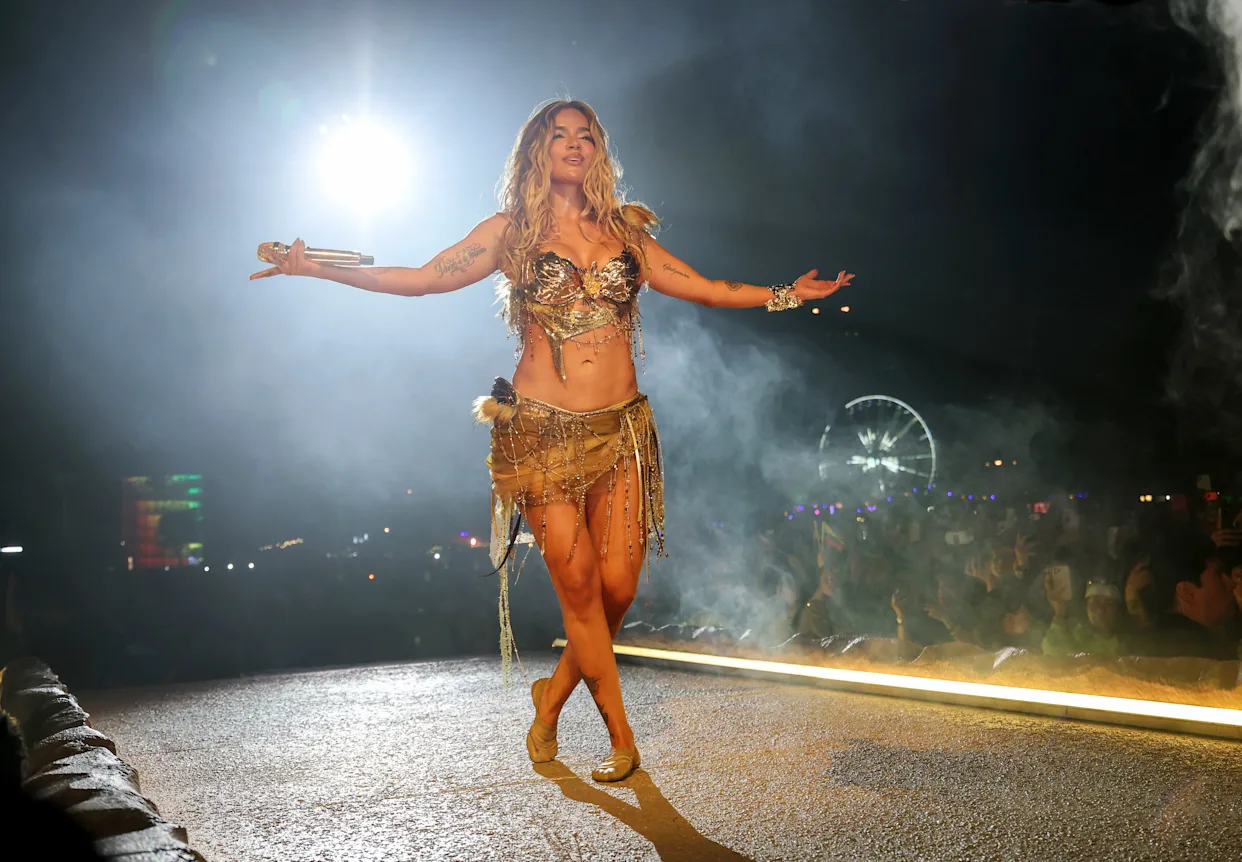
At festivals like Coachella, this kind of trajectory becomes especially visible because the stage functions as a global amplifier. A performance is not just a local event—it is instantly translated into digital circulation, where clips, reactions, and commentary extend its reach far beyond the venue. In that environment, sustained relevance is often more powerful than isolated viral spikes.
Representation in this context operates on two levels. First, there is visibility—being present in spaces that historically excluded or limited certain voices. Second, there is normalization—becoming part of the expected fabric of those spaces rather than an exception within them. Karol G’s continued prominence reflects both shifts occurring simultaneously.
The audience response also plays a role in reinforcing this momentum. Engagement is not limited to one demographic or region; it is distributed across global platforms, creating a feedback loop where demand and visibility strengthen each other. This loop helps convert individual moments into long-term cultural positioning.
Importantly, this kind of success is not only symbolic—it is infrastructural. It influences festival lineups, streaming patterns, brand partnerships, and the broader economics of pop culture visibility. Representation, in this sense, is also market validation, shaping how industries allocate attention and resources.
At Coachella specifically, where global audiences converge in real time, these dynamics become highly concentrated. A single performance or appearance is not isolated—it becomes part of a larger narrative about where pop culture is heading and who is shaping its direction.
Ultimately, “Why Karol G’s Moment Matters” is not about a single event. It is about sustained presence. In 2026, cultural impact is increasingly defined not by isolated breakthroughs, but by the ability to remain central across cycles of attention—and Karol G’s momentum reflects exactly that shift.