Introduction
Award shows like the Grammys have long been defined by spectacle—towering stage designs, choreographed routines, guest appearances, and high-production performances meant to impress millions of viewers worldwide. Yet every so often, an artist chooses to break that formula entirely and deliver something unexpectedly intimate.
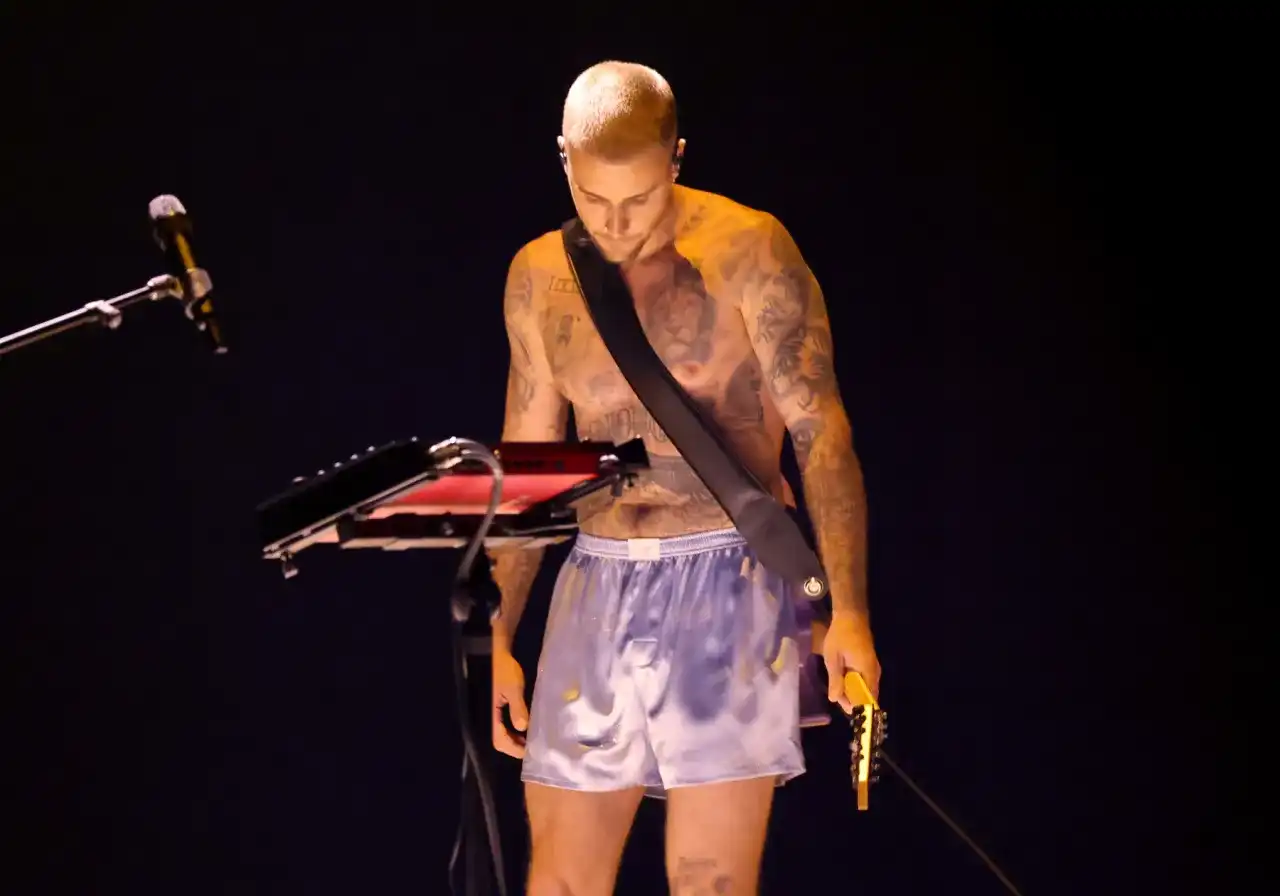
That is exactly what happened when Justin Bieber performed his track “Yukon” in what quickly became one of the most talked-about moments of the night. Stripping away choreography, backing musicians, and even traditional stage theatrics, Bieber delivered a minimalist, emotionally charged performance that shifted the tone of the entire event.
Instead of competing with the high-energy sets that came before him, he created silence. Instead of relying on production, he relied on presence. And instead of spectacle, he delivered vulnerability.
This performance has since been described as one of the most raw and unexpected highlights of the Grammys, sparking widespread discussion about artistry, reinvention, and the future of live music performance.
Setting the Stage: Why This Performance Mattered
The Grammys are known for their competitive energy. Artists often use the platform to showcase their biggest hits in their most polished form, aiming for viral moments and career-defining visuals.
In that environment, Bieber’s decision to perform “Yukon” in a stripped-down format stood out immediately.
Where others leaned into choreography and elaborate production, he chose restraint. This contrast made the performance even more impactful, especially in a night filled with high-energy performances from emerging and established artists.
The choice of song also mattered. “Yukon” is not structured as a traditional pop spectacle track. Instead, it leans into atmospheric production and emotional delivery, making it ideal for a live reinterpretation focused on raw musicianship.
From the very beginning, the audience could sense that this was not going to be a typical Grammy performance.
A Minimalist Stage Approach That Changed the Mood
One of the most striking aspects of the performance was its simplicity. Bieber stepped onto the stage without the usual distractions—no dancers, no elaborate set pieces, and no visual overload.
Instead, the stage was designed to feel open and empty, placing full attention on the artist himself.
This creative decision immediately shifted the energy in the room. Award show audiences are accustomed to sensory overload, but here, the absence of production became the production.
Every movement mattered. Every pause carried weight. Every note felt deliberate.
This minimalist approach created an atmosphere closer to an intimate concert or studio session than a televised awards performance.
Live Looping and Instrumental Control
A defining technical element of the performance was Bieber’s use of live looping. Rather than relying on a backing track, he built the musical foundation of “Yukon” in real time.
By layering guitar sounds live on stage, he created a repeating loop that formed the backbone of the performance. This technique is often associated with artists who prioritize musicianship and live creativity over pre-recorded enhancement.
This approach required precision and control. Any mistake in timing or layering would have disrupted the entire structure of the performance. Instead, Bieber executed it smoothly, reinforcing the sense that this was a carefully crafted artistic moment rather than a spontaneous experiment.
The use of live looping also reinforced a deeper message: the performance was not about perfection, but authenticity.
Vocal Performance and Emotional Delivery
At the center of the performance was Bieber’s vocal delivery, which played a crucial role in shaping audience reaction.
Without heavy production or background instrumentation, his voice was exposed in a way that left no room for distraction. This type of performance demands emotional control, vocal stability, and confidence.
Bieber leaned into a restrained vocal style, focusing on tone, breath, and phrasing rather than vocal acrobatics. This created a sense of intimacy, as though he were performing directly to each viewer rather than to a massive arena.
The emotional weight of the performance came not from volume or spectacle, but from restraint. In many ways, the quieter approach made the lyrics feel more personal and reflective.
Audience Reaction: Silence, Then Applause
One of the most notable aspects of the performance was the audience response.
As Bieber performed, the arena reportedly fell into near silence. In award show environments, silence is rare and often signifies deep engagement. Instead of reacting loudly or visually, the audience appeared to absorb the performance in real time.
At the conclusion, the reaction shifted dramatically. Applause followed, along with visible admiration from fellow performers and industry figures in attendance.
This contrast—silence during the performance and strong applause afterward—highlighted the emotional impact of the moment.
Even veteran performers and industry professionals were seen reacting positively, reinforcing the idea that the performance had crossed the boundary from entertainment into artistic statement.
Critical Commentary and Industry Reaction
Following the broadcast, entertainment commentators and critics quickly began analyzing the performance.
Many praised Bieber’s willingness to step away from traditional pop spectacle and embrace a more stripped-down artistic approach. In an industry where production value often overshadows vocal performance, this shift was seen as refreshing.
Some commentators compared the approach to artists like Ed Sheeran, who have long used loop-based live performances to create full arrangements in real time. However, Bieber’s interpretation was noted for its emotional tone rather than purely technical showcase.
Television hosts and media personalities also contributed to the conversation. The moment was framed as one of the most memorable of the night, with some describing it as a “reset” moment in the flow of the ceremony.
The broader industry response suggested that the performance may influence how future pop artists approach live award show appearances.
Artistic Reinvention and Career Narrative
For Bieber, the “Yukon” performance also fits into a broader narrative of artistic evolution.
Over the years, he has transitioned from teen pop sensation to mature artist exploring deeper emotional and sonic themes. This performance reinforced that shift, presenting him in a more grounded and musically focused light.
Rather than relying on nostalgia or high-energy hits, he chose a song and format that emphasized musicianship and vulnerability.
This type of performance often plays a key role in reshaping public perception of long-standing pop artists. It signals growth, control over artistic identity, and a willingness to take creative risks in high-pressure environments.
In that sense, the performance was not just about “Yukon”—it was about positioning within the broader landscape of modern pop music.
Why Stripped-Down Performances Stand Out Today
In the modern entertainment industry, audiences are constantly exposed to high-production visuals, fast edits, and digitally enhanced performances. As a result, simplicity has become increasingly powerful.
A stripped-down performance forces attention back to fundamentals: voice, emotion, and songwriting.
When executed successfully, this approach can feel more impactful than elaborate staging because it removes distraction and highlights authenticity.
Bieber’s “Yukon” performance fits directly into this trend. It demonstrates that in a world of constant visual stimulation, restraint can become a form of artistic power.
The Future Impact: What This Means for Live Pop Performance
The ripple effect of this performance may extend beyond a single award show moment.
Artists watching from the audience and at home are likely to take note of how effectively simplicity resonated with viewers. This could influence future Grammy performances and live televised appearances.
Instead of competing solely through production scale, more artists may begin experimenting with minimalism, live instrumentation, and raw vocal presentation.
If this trend continues, it could mark a shift in how award show performances are designed and evaluated.
Conclusion
Justin Bieber’s performance of “Yukon” at the Grammys stands out as one of the most unexpected and talked-about moments of the night. By removing traditional performance elements and focusing on live musicianship, emotional delivery, and simplicity, he delivered a moment that felt both intimate and powerful.
Justin Bieber used this performance not just to showcase a song, but to redefine how he can be seen as a live performer in a high-pressure global setting.
In a night filled with spectacle, he chose silence. In a world driven by production, he chose restraint. And in doing so, he created a performance that resonated far beyond the stage.
Whether viewed as a creative risk, a career statement, or a pure artistic moment, “Yukon” ultimately proved that sometimes the most powerful performances are the ones that strip everything away.