For decades, Wile E. Coyote has been one of animation’s most persistent underdogs. He has been blown up, flattened, launched into the sky, dropped from cliffs, and repeatedly defeated by his own increasingly ridiculous ACME inventions, all in pursuit of one seemingly impossible goal: catching the Road Runner. In Coyote vs. Acme, that familiar setup gets a surprisingly clever twist. Instead of simply ordering another gadget and trying again, Wile E. Coyote finally decides that enough is enough. He takes ACME to court.
Directed by Dave Green, Coyote vs. Acme combines live-action performances with animated Looney Tunes characters to create a comedy that is nostalgic without feeling completely stuck in the past. The movie stars Will Forte as personal-injury lawyer Kevin Avery, John Cena as ACME’s attorney Buddy Crane, and Lana Condor as Paige Avery, with several classic Looney Tunes characters appearing throughout the story. The film was released theatrically on August 28, 2026.
What makes the movie especially interesting is that its real-world history almost mirrors its fictional story. Coyote vs. Acme was completed before Warner Bros. shelved it in 2023 as part of a tax strategy. After significant fan and industry backlash, the movie eventually found a new path to theaters through Ketchup Entertainment. That unusual journey makes the movie’s eventual release feel almost like a victory for the very underdog it puts at the center of its story.
What Is Coyote vs. Acme About?
At its heart, Coyote vs. Acme is a courtroom comedy built around one of the simplest jokes in Looney Tunes history: ACME products never seem to work for Wile E. Coyote. After years of disastrous purchases, the coyote decides to fight back against the company responsible for his endless injuries and failures.
His legal battle brings him together with Kevin Avery, a struggling Albuquerque personal-injury lawyer who has previously handled small claims involving ACME. Kevin is not exactly the fearless courtroom hero Wile E. needs. He is accustomed to settling cases quickly and accepting modest payouts rather than taking on powerful corporations.
The situation changes when Wile E. refuses to accept another settlement and the case becomes much bigger than anyone expected. Suddenly, Kevin and his team are facing ACME’s powerful legal operation, represented by Buddy Crane, played by John Cena. The conflict becomes a classic David-versus-Goliath story, except the David is a silent animated coyote who has spent his entire existence being crushed by anvils.
That premise sounds simple, but it gives the filmmakers plenty of room to play with comedy, corporate satire, legal humor, and the long history of the Looney Tunes franchise.
A Clever New Direction for Wile E. Coyote
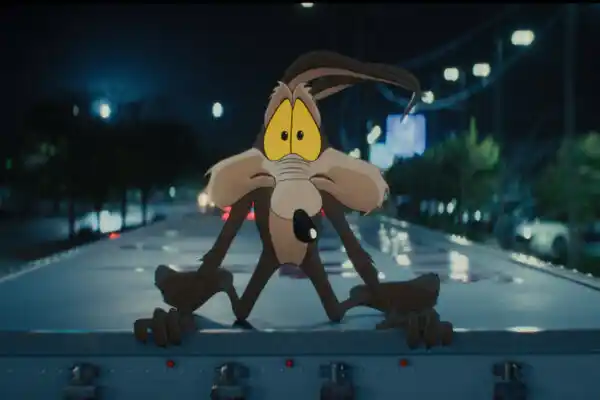
One of the smartest decisions in Coyote vs. Acme is making Wile E. Coyote the center of a story rather than treating him as a supporting cartoon character. Bugs Bunny may be the most recognizable face of Looney Tunes, but Wile E. Coyote has always represented something different. He is ambitious, stubborn, imaginative, and almost impossibly determined.
The joke has never simply been that Wile E. Coyote fails. The joke is that he fails spectacularly and still gets back up. Every explosion, falling rock, broken rocket, and disastrous invention somehow leads to another attempt.
The movie understands that quality and turns it into the emotional foundation of the story. Wile E. is no longer simply trying to catch the Road Runner. He is trying to hold a powerful corporation accountable for years of products that have repeatedly gone wrong.
That gives the character something he has rarely had in previous appearances: a genuine cause.
The result is a surprisingly effective transformation. The same character who was once simply the victim of a cartoon gag becomes an underdog audiences can actually root for.
Will Forte Brings the Human Side of the Story
A live-action and animation hybrid needs a human character who can convincingly exist alongside cartoon characters without making the world feel ridiculous in the wrong way. Will Forte is a strong choice for that role.
As Kevin Avery, Forte plays a lawyer who is far less confident than the situation requires. He is not introduced as a brilliant courtroom strategist who always knows what to do. Instead, he is a relatively ordinary professional who finds himself pulled into an extraordinary case.
That makes Kevin an effective audience surrogate. The audience can discover the absurdity of the Looney Tunes world through him while still taking the emotional stakes seriously.
Forte also understands the value of understatement. The movie does not require him to compete with the animated characters by acting bigger and louder than everyone else. Instead, his reactions help make the cartoon chaos funnier.
Critics have particularly highlighted the way Forte works as the human counterbalance to Wile E. Coyote’s animated world. RogerEbert.com’s review praised the movie’s combination of clever humor and emotional warmth, while noting that Forte helps anchor the live-action side of the story.
John Cena Is Perfectly Cast as ACME’s Lawyer
John Cena has become increasingly comfortable with comedy, and Coyote vs. Acme gives him another opportunity to lean into his exaggerated screen presence.
As Buddy Crane, Cena plays the opposing attorney representing ACME. Buddy is confident, intimidating, polished, and seemingly comfortable operating within the corporate system. His personality provides a natural contrast to Forte’s more nervous Kevin Avery.
The casting works because Cena already has the physical presence of a larger-than-life cartoon character. His broad expressions and imposing appearance fit naturally into a movie where humans and animated characters are expected to share the same universe.
The rivalry between Kevin and Buddy also adds a human layer to the courtroom story. Their conflict is not simply about Wile E. Coyote versus ACME. It becomes a clash between two former acquaintances who have taken very different approaches to their careers.
That relationship gives the legal comedy more substance than a series of disconnected jokes.
The Looney Tunes Characters Are More Than Nostalgia
A major selling point of Coyote vs. Acme is obviously the opportunity to see familiar Looney Tunes characters again. Bugs Bunny, Daffy Duck, Tweety, Porky Pig, Taz, Foghorn Leghorn, and other recognizable characters appear throughout the movie.
However, the movie works best when these characters are not simply inserted into scenes for the sake of nostalgia.
Their appearances help establish that this is genuinely a shared Looney Tunes world. The filmmakers understand that longtime fans want recognizable characters, familiar personalities, visual jokes, and references to the cartoons they grew up watching.
At the same time, the story does not require audiences to know every detail of Looney Tunes history to understand what is happening. That balance is important because a modern family movie needs to work for multiple generations.
Older viewers can appreciate the references while younger audiences can enjoy the characters and physical comedy on their own terms.
The Animation and Live Action Blend Works
Mixing animated characters with live-action actors is not new. Movies such as Who Framed Roger Rabbit and Space Jam established that audiences are comfortable seeing cartoon characters interact with humans.
The challenge is making the combination feel natural rather than gimmicky.
Coyote vs. Acme largely succeeds because the filmmakers understand the exaggerated physical logic of Looney Tunes. The animated characters do not suddenly behave like realistic creatures simply because they are sharing scenes with humans. They remain cartoons.
That allows the movie to preserve the visual language that made Wile E. Coyote famous in the first place.
The live-action environments provide a grounded backdrop, while the animated characters bring the impossible physics. That contrast creates many of the movie’s funniest moments.
The Comedy Goes Beyond Slapstick
Fans coming to Coyote vs. Acme expecting classic Looney Tunes chaos will not be disappointed. There are plenty of physical gags and cartoon-inspired jokes.
But the film also has another layer of comedy: satire.
The idea of a corporation that continually sells products that cause catastrophic injuries is already an absurd exaggeration of corporate responsibility. Turning that idea into a courtroom battle allows the movie to poke fun at corporate power, advertising, legal settlements, and the enormous imbalance between an individual and a massive company.
This is one of the reasons the film has connected with critics. Reviews have highlighted its ability to combine slapstick humor with sharper satire and emotional elements. Ars Technica described the film as a love letter to Looney Tunes while praising its blend of humor and pointed satire.
The comedy therefore works on multiple levels. Children can laugh when something explodes. Adults can recognize the absurdity of the corporate jokes underneath it.
Why the Movie’s Real-Life Story Makes It Even More Interesting
Perhaps the strangest part of Coyote vs. Acme is that the movie’s real-world journey resembles its fictional story.
In the film, Wile E. Coyote refuses to give up against a powerful corporation. In real life, the completed movie was shelved by Warner Bros. before eventually being rescued following widespread support from fans and people within the entertainment industry. Ketchup Entertainment ultimately acquired the movie for release.
That makes the movie’s underdog theme difficult to ignore.
Audiences are not simply watching a fictional character fight against a giant corporation. They are also watching a film that survived a corporate decision that appeared to end its future.
The parallel gives the movie an unexpected emotional quality. Its journey to theaters becomes part of its identity.
A Surprisingly Heartfelt Underdog Story
The strongest aspect of Coyote vs. Acme may not actually be the jokes. It is the message underneath them.
Wile E. Coyote has failed more times than almost any other fictional character. Yet failure has never stopped him.
That makes him an unusually effective symbol of persistence. He continues chasing an impossible goal even when logic says he should quit.
The film takes that familiar characteristic and expands it into a story about standing up for yourself. Wile E. may be ridiculous, but his frustration is understandable. He has spent decades buying products that repeatedly fail him, and now he wants someone to listen.
The movie’s courtroom setup allows that simple cartoon premise to become a story about perseverance, justice, and refusing to accept defeat.
That emotional foundation is part of what separates Coyote vs. Acme from a basic nostalgia-driven reboot.
Is Coyote vs. Acme Worth Watching?
For fans of Looney Tunes, the answer is an easy yes. The movie offers familiar characters, visual comedy, classic cartoon energy, and plenty of references for longtime viewers.
But even people who are not deeply familiar with Looney Tunes may find something to enjoy. The central legal story is accessible, the human characters give the movie emotional grounding, and the satire gives adults something more to appreciate.
The critical response has also been notably strong. The film entered release with a 96% Fresh rating on Rotten Tomatoes during its pre-release review period, reflecting overwhelmingly positive critical reactions.
That reception makes sense because the movie is attempting something more ambitious than simply bringing old cartoon characters back to the screen. It is trying to understand why those characters have lasted for so long in the first place.
Final Verdict: More Than a Cartoon Comeback
Coyote vs. Acme could easily have been nothing more than another nostalgia-driven attempt to revive a familiar franchise. Instead, it turns one of animation’s oldest running jokes into a surprisingly smart courtroom comedy about persistence, corporate power, friendship, and standing up for yourself.
The combination of Will Forte’s grounded performance, John Cena’s comedic energy, Lana Condor’s contribution, and the unmistakable personalities of the Looney Tunes characters gives the movie a distinctive identity.
More importantly, the movie’s own journey makes its themes feel strangely appropriate. Wile E. Coyote spends his entire life getting knocked down and trying again. Coyote vs. Acme itself was nearly knocked out of existence before eventually finding its way to audiences.
That makes the film’s biggest message surprisingly fitting: sometimes the underdog really does get another chance.
For longtime Looney Tunes fans, Coyote vs. Acme is a welcome return to a world of cartoon chaos. For families, it is an accessible comedy with enough visual humor to entertain younger viewers and enough satire to keep adults engaged. And for anyone interested in the increasingly unusual relationship between Hollywood, corporations, and creative projects, the film’s real-world history adds another fascinating layer.
Coyote vs. Acme is funny, nostalgic, occasionally heartfelt, and considerably smarter than its premise initially suggests. It is not simply about a coyote suing a company for defective products. It is about what happens when someone who has spent a lifetime losing finally decides that losing is no longer an option.
And after everything this movie went through to reach theaters, that may be the most fitting joke of all.